ADA Website Compliance Services Your Essential Guide

Sidharth Nayyar
TL;DR:
ADA website compliance services help make your website accessible to people with disabilities, a legal requirement under the Americans with Disabilities Act (ADA). These services range from expert audits to automated software and ongoing support, ensuring your site meets standards like WCAG. Making your site accessible is not just about avoiding lawsuits; it expands your market, improves user experience for everyone, boosts SEO, and strengthens your brand reputation.
ADA Website Compliance Services
Here's a quick rundown: ADA website compliance services are professional solutions designed to make your digital content accessible to people with disabilities, a requirement under the Americans with Disabilities Act (ADA). These services can range from in-depth expert audits to automated software tools, all focused on finding and fixing issues that prevent everyone from having equal access to your website.
What Are ADA Website Compliance Services?
Think of your website as the digital front door to your business. Just like a physical store needs a ramp for wheelchair access, your website needs to be designed so that people with disabilities can get in, look around, and interact with everything easily. ADA website compliance services are the experts and tools that help you build that digital ramp.
These specialized services use a mix of technology and human know-how to make sure your website and all its content are usable by everyone, regardless of their physical or cognitive abilities. This isn’t just a nice thing to do; it’s a legal obligation under the Americans with Disabilities Act. The whole point is to tear down digital barriers that might block someone from using your site.
Breaking Down the Core Function
At their core, these services are all about providing a fair and equal experience for every single user. This means designing for people with a wide range of needs, including:
Visual impairments: Users who rely on screen readers to "hear" the content on a page.
Auditory impairments: Individuals who need captions or transcripts to understand video and audio content.
Motor impairments: People who can't use a mouse and depend on keyboard-only navigation.
Cognitive disabilities: Users who benefit from simple, consistent layouts and clear instructions.
To get there, professional services check your site against established standards—most notably the Web Content Accessibility Guidelines (WCAG)—to pinpoint and fix problems. Following established guidelines is key, and you can learn more about these core ideas in these Top 8 Website Accessibility Best Practices.
When you bring in a professional service, they're essentially giving your website a comprehensive check-up. They identify issues, provide a clear roadmap for repairs, and help you implement the fixes needed to open your digital doors to everyone. The table below breaks down the key components you can expect from these services.
Core Components of ADA Website Compliance Services
A snapshot of the key functions and outcomes of engaging professional ADA compliance services.
| Component | Description | Primary Benefit |
|---|---|---|
| Accessibility Audits | A thorough review of your website against WCAG standards, performed by experts and automated tools. | Identifies specific, actionable barriers that are preventing users from accessing your content. |
| Remediation & Repair | Hands-on assistance to fix the accessibility issues discovered during the audit. | Ensures your website is not just diagnosed but actually becomes compliant and user-friendly. |
| Ongoing Monitoring | Continuous scanning of your site to catch new accessibility problems as content is updated. | Maintains compliance over time and prevents your site from falling out of legal and functional standards. |
| Legal Support | Provides documentation, certifications, and expert guidance in case of a legal complaint. | Reduces legal risk by demonstrating a proactive and documented commitment to accessibility. |
These components work together to provide a complete solution, moving beyond a one-time fix to create a sustainably accessible digital presence.
Why Proactive Compliance Is a Must
Putting off digital accessibility isn't just risky—it's bad business. Ignoring it opens you up to expensive lawsuits and brand damage. More importantly, it means you're intentionally or unintentionally shutting out a huge part of the market. Over one in four adults in the U.S. lives with some form of disability.
By making accessibility a priority, you're doing more than just protecting your company from legal trouble. You're showing a real commitment to inclusivity. This proactive mindset strengthens your brand's reputation and welcomes a much wider audience, turning a legal requirement into a genuine business advantage.
Why ADA Website Compliance Is a Business Imperative
Think of your website as your digital front door. It’s often the very first place a potential customer interacts with your brand, browses your offerings, and decides if they want to stick around. Just like a physical shop needs a ramp for wheelchair access, your website needs to be built so that everyone, including people with disabilities, can get in and navigate easily.
This is the core idea behind the Americans with Disabilities Act (ADA) when it comes to the online world. The law is clear: businesses must provide the same level of access to their digital information and services for people with disabilities as they do for everyone else. This isn't just a nice-to-have feature; it's a civil right.
The Legal and Ethical Case for Access
At its heart, ADA website compliance is about tearing down digital barriers. Imagine someone with a visual impairment using a screen reader. If your website’s images don’t have descriptive text, they encounter a frustrating void where crucial information should be. Or consider someone with a motor disability who can't use a mouse—a site that can’t be navigated with a keyboard is a dead end for them.
These kinds of obstacles effectively shut out a huge segment of the population. This creates two distinct but related obligations for any business.
Your Legal Duty: The U.S. Department of Justice has been consistent in stating that ADA requirements apply to websites. Failing to comply isn't a simple technical error; it's a legal risk that can lead to expensive lawsuits and fines.
Your Ethical Duty: Legalities aside, there’s a powerful human reason to make your site accessible. An inclusive online experience shows you respect every individual and are committed to equality, which goes a long way in building your brand's character.
An accessible website is a reflection of an inclusive business philosophy. It signals to every visitor that they are valued, respected, and welcome, transforming a legal obligation into a powerful statement of corporate responsibility.
Ignoring accessibility has become a high-stakes gamble. The need for ADA website compliance services is more urgent than ever, driven by a sharp increase in legal challenges. By the end of 2024, ADA Title III complaints rose by 7%, hitting a total of 8,800 lawsuits. The trend didn't stop there; the first half of 2025 saw a 37% spike in ADA website accessibility lawsuits, with 2,014 cases filed. This surge in legal action makes it plain: being proactive is no longer optional. You can dig into the numbers and see what this means for businesses by learning about website accessibility lawsuit trends.
Protecting Your Brand and Reputation
Failing to address digital accessibility does more than just open you up to lawsuits—it can seriously tarnish your brand's reputation. Today’s consumers want to support companies that do the right thing. A website that excludes an entire community can make your business look discriminatory and out of step with modern values.
That kind of perception can spark negative press, alienate customers, and erode the trust you've worked so hard to build. On the flip side, taking accessibility seriously sends a powerful, positive message. It shows you’re a thoughtful, forward-thinking company that genuinely cares about serving everyone.
By investing in ADA website compliance, you're doing much more than checking off a legal requirement. You’re building a stronger, more respected, and more welcoming brand that connects with a wider audience. It's a strategic move that turns a potential liability into a real competitive advantage, fostering customer loyalty and setting you up for long-term growth.
If you want remediation handled end to end, WebAbility's ADA compliance services cover the audit, the fixes, and an owned conformance report.
Navigating the Core Accessibility Standards like WCAG
Making a website accessible isn't a shot in the dark. It’s about following a clear, internationally recognized roadmap. ADA website compliance services don't just make up their own rules; they work to align your digital presence with established technical standards that spell out exactly what makes a website usable for everyone.
The cornerstone of this whole world is the Web Content Accessibility Guidelines (WCAG). You can think of WCAG as the universal instruction manual for building an inclusive web. It gives designers, developers, and content teams a shared rulebook to follow, ensuring their work doesn't accidentally shut out people with disabilities.
Understanding WCAG Conformance Levels
WCAG is cleverly broken down into three levels. This tiered system gives organizations a practical way to set goals and measure progress.
Level A (The Foundation): This is your starting point. Meeting Level A criteria knocks out the most critical and common barriers that people with disabilities face online. A classic example is adding text alternatives (alt text) to your images so screen readers can describe them.
Level AA (The Industry Standard): This is the sweet spot and the level most businesses aim for. It's the standard most often cited in legal settlements and what's generally considered a strong, accessible experience. Ensuring your text has enough color contrast against its background is a key Level AA requirement.
Level AAA (The Gold Standard): This is the highest you can go. The requirements here are much more specific and demanding. While not always practical or required, hitting Level AAA criteria makes a huge difference for certain users. For instance, providing sign language interpretation for all pre-recorded videos is a AAA guideline.
If you want to get into the nitty-gritty, our guide to navigating WCAG breaks down each level in detail. For almost any business, though, WCAG 2.1 Level AA is the benchmark you want to hit to show you're serious about compliance.
The infographic below really drives home why this is about more than just technical rules—it's a core business responsibility.
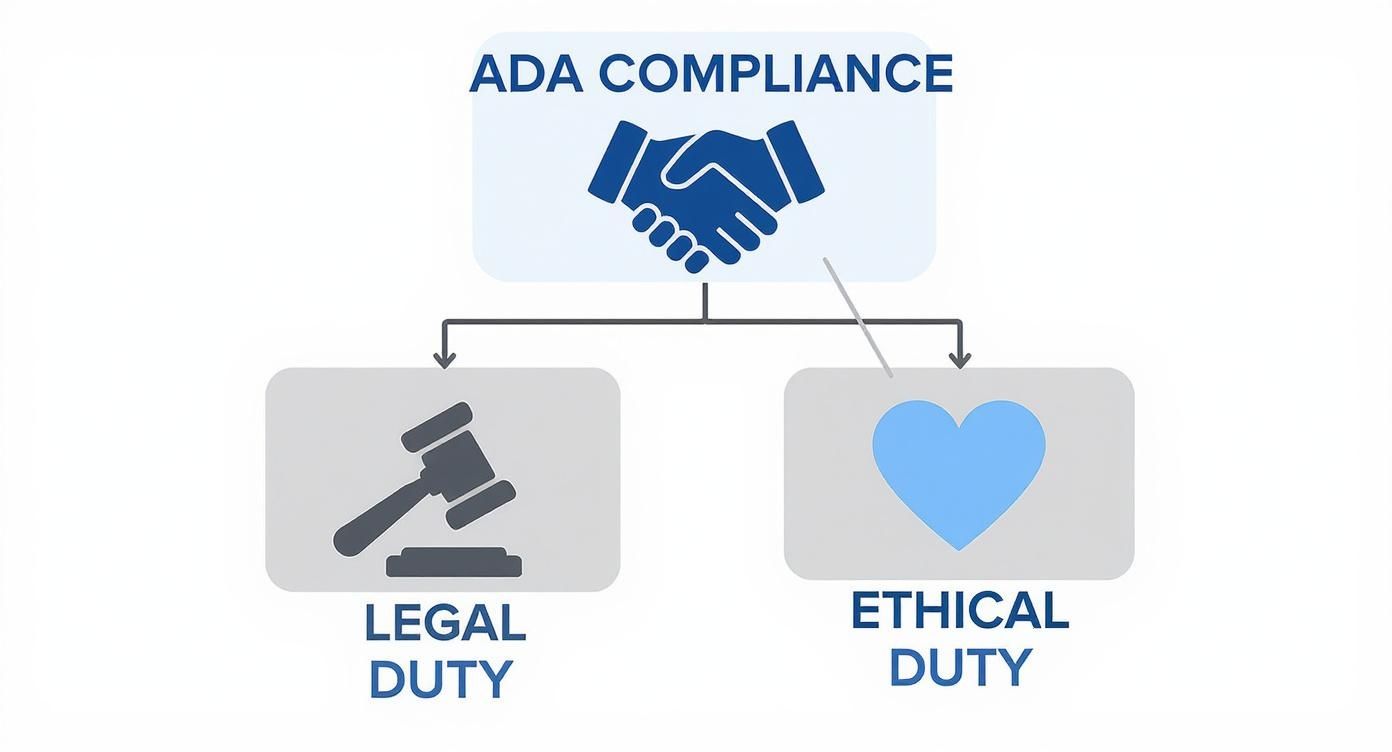
As you can see, this isn't just about avoiding a lawsuit. It's about doing the right thing and making a smart business decision at the same time.
Beyond WCAG: A Global Perspective
While WCAG sets the global rhythm, other important standards and laws exist that you should know about, especially if you operate in specific regions or sectors.
Accessibility is not a feature to be added at the end of a project. It is a foundational principle that must be integrated from the very beginning, ensuring that every design choice and line of code contributes to an experience that is open to all.
The good news? Most of these regulations point right back to WCAG as their technical guide, which creates a pretty consistent set of expectations around the world. Here are the big ones:
Section 508 (United States): This is a U.S. law that mandates federal agencies make their technology accessible. It specifically points to WCAG 2.0 AA, so if you do any business with the government, you absolutely need to comply.
AODA (Ontario, Canada): The Accessibility for Ontarians with Disabilities Act sets accessibility rules for organizations in Ontario. Unsurprisingly, its standards for websites also reference WCAG 2.0 AA.
EN 301 549 (European Union): This is Europe's official standard for digital accessibility, legally required for public sector websites and apps across the EU. It’s also built to harmonize with WCAG, creating a unified accessibility landscape in Europe.
By getting familiar with these core standards, you start to see that the work of ADA website compliance services is grounded in a solid, global framework. They are the experts who translate these technical rules into real-world changes that make your website work for everyone, everywhere.
Here's a breakdown of the main ways you can tackle ADA website compliance.
Exploring the Different Types of Compliance Services
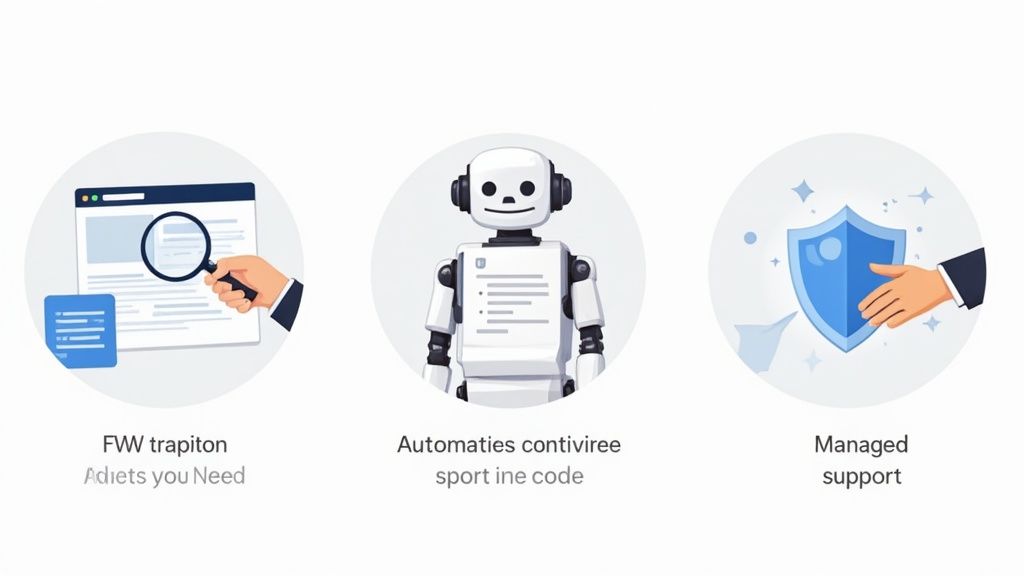
Trying to figure out ADA website compliance services is a bit like choosing how to get across the country. Do you need a reliable sedan for a straightforward highway drive, a rugged 4x4 for unpredictable terrain, or a high-tech electric car that handles a lot of the work for you? They’ll all get you there, but the best fit depends on your budget, timeline, and how hands-on you want to be.
Compliance services work the same way. Each offers a different path to making your website accessible to everyone. Getting to know these models is the first real step in creating an accessibility plan that actually works for your organization.
Let's break down the main options you’ll come across.
Manual Accessibility Audits
Think of a manual audit as a meticulous, hands-on inspection of your website by a team of accessibility experts. These pros, who often include people with disabilities, don’t just rely on software; they use assistive technologies like screen readers to navigate your site just like a real user would.
They go beyond a simple checklist to uncover the kind of nuanced issues automated tools can't see—things like a confusing checkout process or content that’s logically out of order. A full accessibility audit delivers a detailed report that not only flags every issue but also provides specific, code-level advice on how to fix it.
A manual audit is the gold standard for truly understanding your user experience. It gets past the simple pass/fail scores and gives you a real-world picture of how people with disabilities interact with your site.
Ultimately, this approach gives you a clear, comprehensive roadmap for fixing the problems that matter most, making it the bedrock of any serious compliance effort.
Automated Scanning Tools
If a manual audit is the deep-dive inspection, automated tools are your 24/7 security system. This software constantly scans your website to find common accessibility errors based on WCAG rules. It’s like a smoke detector for your code, alerting you to problems like missing alt text for images, low-contrast text, or form fields without proper labels.
Automated tools are incredibly fast and efficient at spotting technical slip-ups across thousands of pages. Their main strengths are:
Speed: Scans are done in minutes, giving you instant feedback.
Scale: They can check an entire site automatically, a task that’s impossible to do by hand.
Consistency: The checks are objective and based on a fixed set of rules.
Most of these tools provide a dashboard where you can track your accessibility score over time, spot trends, and tackle recurring issues, helping your team build and maintain good habits.
Managed Accessibility and Widgets
Managed accessibility services offer a hybrid approach, blending powerful technology with human expertise. This model combines the speed of automated scanning with the insight of manual testing and often includes hands-on help with remediation. A common feature here is an accessibility widget or overlay.
These widgets add a toolbar to your site that lets visitors make their own adjustments, like increasing font sizes, switching to a high-contrast mode, or activating a text-to-speech feature. Meanwhile, on the back end, the service uses AI and other tech to apply automatic fixes to many common accessibility barriers.
The rise of these services is no surprise. The accessibility software market was valued at $670.37 million in 2023 and is on track to hit $1,373.92 million by 2032. This growth isn't just about avoiding lawsuits; it's about businesses recognizing the value of digital inclusion. You can learn more about the growth of the digital accessibility market.
This combined approach lets you make immediate improvements while you work on more permanent, code-level fixes. It strikes a balance between quick wins and long-term compliance, making it a go-to choice for organizations that want a comprehensive solution.
tldr Picking the right ADA compliance partner isn't about a quick fix. You need to look at their actual expertise, how complete their services are—from audits to ongoing help—and the tech they bring to the table. A real partner gives you a long-term game plan, clear reports, and dedicated support to navigate the often-confusing world of digital accessibility.
How to Choose the Right ADA Compliance Partner
Choosing a provider for ADA website compliance services is a critical step on your accessibility journey. This decision is less about buying a product and much more about finding a true partner who can guide you through the entire process. The right fit will be a blend of smart technology, deep expertise, and a genuine commitment to your long-term success.
Think of it like hiring an architect. You wouldn't just pick someone who can draw a blueprint. You'd want an expert who gets structural integrity, knows the local building codes inside and out, and understands your vision for the space. In the same way, a great compliance partner does more than just run a scan; they help you build a solid, sustainable accessibility framework for your entire digital presence.
Evaluate Their Depth of Expertise
First things first: how much do they really know? True accessibility expertise goes way beyond memorizing WCAG checklists. It requires a deep understanding of how people with different disabilities actually interact with the web and the assistive technologies they rely on.
Look for a team with a proven track record. Can they show you case studies or testimonials from businesses similar to yours? A provider with years in the trenches will understand the nuances of compliance and offer strategic advice, not just a list of technical fixes.
Assess the Comprehensiveness of Their Solutions
A one-time audit is not a strategy. Your website is a living thing—it's constantly changing with new content, features, and designs. That means accessibility has to be an ongoing commitment, not a one-and-done task. The best partners offer a full spectrum of services to support you at every stage.
You should be looking for a holistic approach that includes:
Initial Auditing: A thorough diagnostic of your current accessibility health, using a smart mix of automated scanning and expert manual testing.
Guided Remediation: Clear, actionable instructions for your development team to fix the problems right at the code level.
Ongoing Monitoring: Continuous scanning and reporting to catch new issues as they pop up, helping you stay compliant over time.
Training and Support: Educational resources and access to experts to help your team build their own accessibility skills and create a more inclusive culture.
A complete solution ensures you aren't left on your own, wondering what to do next. As you evaluate your options, keep in mind that many specialized web design companies are now building accessibility into their development process from the very beginning, offering a more integrated approach.
Your goal is to find a partner who empowers you, not one who creates dependency. They should give your team the tools and knowledge to make accessibility a natural part of your workflow, turning compliance from a reactive chore into a proactive value.
Key Questions to Ask Potential Partners
To find the right fit, you have to ask the right questions. This goes beyond just features; you need to understand their process, their philosophy, and what they consider a successful partnership.
Here are a few essential questions to guide your conversations:
What does your audit process actually involve? Are you just relying on automated tools, or do you include manual testing with real assistive technologies?
How will you help our team with remediation? Do your experts provide code-level suggestions and actually talk to our developers?
What do your reports look like? Can we see clear progress, track our compliance score over time, and get the documentation we might need for legal purposes?
How will you help us stay compliant? What tools and support do you offer for ongoing monitoring and team training?
What’s your approach to legal support and documentation? How do you help clients show their commitment to accessibility if they face a legal challenge?
By digging into these areas, you can get past the sales pitch and find a partner who truly gets what you need. For those looking for a solution that combines powerful technology with expert oversight, learning more about a managed accessibility service can give you a clear picture of what a comprehensive partnership looks like.
tldr Don't just think of ADA website compliance services as a way to avoid lawsuits. Think bigger. This is about unlocking serious business growth by opening your doors to millions of new customers, getting a natural SEO boost from Google's best practices, and making your website better for every single visitor. It’s a smart investment that shows the world you're an inclusive, modern company.
The Real Business Benefits of Web Accessibility

If you're only looking at web accessibility to check a legal box, you're missing the bigger picture. Yes, compliance is crucial for avoiding costly legal headaches, but the real story here is about growth. Investing in ADA website compliance services is one of the smartest things you can do for your business, with returns that echo far beyond your legal team.
Think of it as a strategic upgrade that strengthens your brand, expands your audience, and directly improves your bottom line. An accessible website isn't just a compliant website—it's a better website for everyone.
Expand Your Market and Boost Revenue
Right off the bat, one of the most tangible benefits is tapping into a massive, often ignored, market segment. More than a billion people worldwide live with some form of disability, and they have significant spending power. By ensuring your website is usable for them, you aren't just being a good corporate citizen; you're creating entirely new revenue streams.
Businesses that don't prioritize accessibility are literally turning customers away. In fact, ignoring customers with disabilities can cost companies an estimated $225 billion annually. On the flip side, brands that embrace accessibility can see their online sales climb by as much as 30% by earning the loyalty of this underserved audience. You can learn more about the economic impact of web accessibility and see just how powerful this can be.
Enhance the User Experience for Everyone
Here's the secret: the principles of accessible design are just the principles of good design. The changes you make for users with disabilities almost always result in a smoother, more enjoyable experience for all your visitors.
It’s a lot like the curb cuts you see on sidewalks. They were originally designed for people in wheelchairs, but they ended up helping parents pushing strollers, travelers pulling luggage, and delivery drivers with handcarts. Accessibility features on your website work the same way—they offer universal benefits.
Clear navigation, readable fonts, high-contrast color schemes, and captioned videos don't just help a few people; they help everyone. This improved user experience (UX) naturally leads to more engagement, longer visits, and better conversion rates across your entire audience.
Improve Your SEO Performance
There’s a surprisingly strong link between web accessibility and search engine optimization (SEO). As it turns out, many of the best practices for making a site compliant with guidelines like WCAG are the very same things search engines like Google want to see.
Alt Text for Images: This is essential for screen readers, but it also gives search engine crawlers critical context about your images, helping them show up in image searches.
Logical Heading Structure: Using H1, H2, and H3 tags correctly helps users with assistive tech navigate a page. It also helps Google understand the structure and importance of your content.
Video Transcripts: Transcripts are a lifeline for users with hearing impairments, and they also provide a keyword-rich text that search engines can easily crawl and index.
By making your site more accessible, you’re also checking off some major technical SEO boxes, which can lead to better rankings and more organic traffic without any extra effort.
Strengthen Your Brand Reputation
In a crowded marketplace, what people think of your brand can make or break you. Committing to accessibility sends a powerful message: your company is inclusive, thoughtful, and modern. It proves you value every customer, and that kind of trust builds deep brand loyalty.
This positive reputation can become a true competitive advantage, attracting customers who actively seek out and support businesses that align with their own values.
tldr; Wondering about ADA compliance? Costs are tied to your site's complexity, a widget alone isn't a magic bullet for compliance, and real accessibility is a continuous commitment, not a one-off task. And yes, the law almost certainly applies to your business, no matter how small.
Common Questions About ADA Compliance Services
When you start digging into ADA website compliance, a few key questions pop up almost immediately. Let's cut through the noise and get straight to the practical answers you need.
What Is the Typical Cost of ADA Compliance Services?
There's really no one-size-fits-all answer here. The cost depends entirely on your specific situation, mostly driven by the size and complexity of your website. A simple five-page business site is going to be a much smaller project than a sprawling e-commerce store with thousands of product pages and interactive features.
A few other things that move the needle on price are:
The approach you take: A deep-dive manual audit by experts who then fix the code will naturally cost more than just subscribing to an automated scanning tool.
Your site's current condition: If your site was built with some accessibility principles from the get-go, the lift will be much lighter than for a site with major, deep-seated code issues.
Ongoing support: The level of continuous monitoring and maintenance you need will also be a factor in the final cost.
Can a Simple Widget Make My Site Fully Compliant?
This is probably one of the most common questions out there, and the answer is nuanced. Accessibility widgets and overlays are fantastic tools. They can make a real difference for users by letting them instantly adjust things like text size and color contrast, which fixes a lot of low-hanging fruit.
But they're not a complete solution on their own. Think of a widget as a helpful coat of paint, but true compliance means making sure the building's foundation is solid. Widgets can't fix fundamental problems in your site's code, especially the kind that trip up screen readers or prevent keyboard-only navigation.
A widget is a powerful feature that enhances user experience, while deep remediation ensures the website's core structure is sound. The best approach combines the immediate benefits of user-facing tools with the fundamental integrity of clean, accessible code.
How Long Does It Take to Achieve Compliance?
Getting your site compliant for the first time is a project with a definite timeline. Maintaining it, however, is an ongoing commitment. The initial audit and fixing process can take anywhere from a few weeks to several months, all depending on—you guessed it—your site's size and the depth of the issues found.
Once that first big push is done, accessibility needs to become part of your routine. Every time you add a new blog post, update a page, or launch a new feature, you have to make sure it's also accessible. The goal is to weave accessibility into your day-to-day workflow, so it’s not just a one-and-done project you have to worry about later.
Does My Small Business Need to Be ADA Compliant?
The short answer is yes, almost certainly. The Americans with Disabilities Act covers businesses that fall under "public accommodations," and courts have consistently ruled that this includes websites. This broad definition applies to the vast majority of businesses, no matter their size.
There isn't a magic number of employees that gives you a pass. If your business is open to the public in any way, your website needs to be open to everyone, too.
Ready to make your website accessible to everyone and protect your business? WebAbility.io offers a complete solution that combines powerful AI technology with expert guidance to ensure your site meets and maintains ADA and WCAG compliance. Start your journey toward a more inclusive web today.
Quick Questions
Tap to ask AI about this article